Modular wastewater treatment for data centers.

Interlock deploys containerized treatment systems tailored to each data center’s cooling-water blowdown and local discharge limits, providing a faster path to compliance than cooling-system redesign or the construction of permanent wastewater infrastructure.
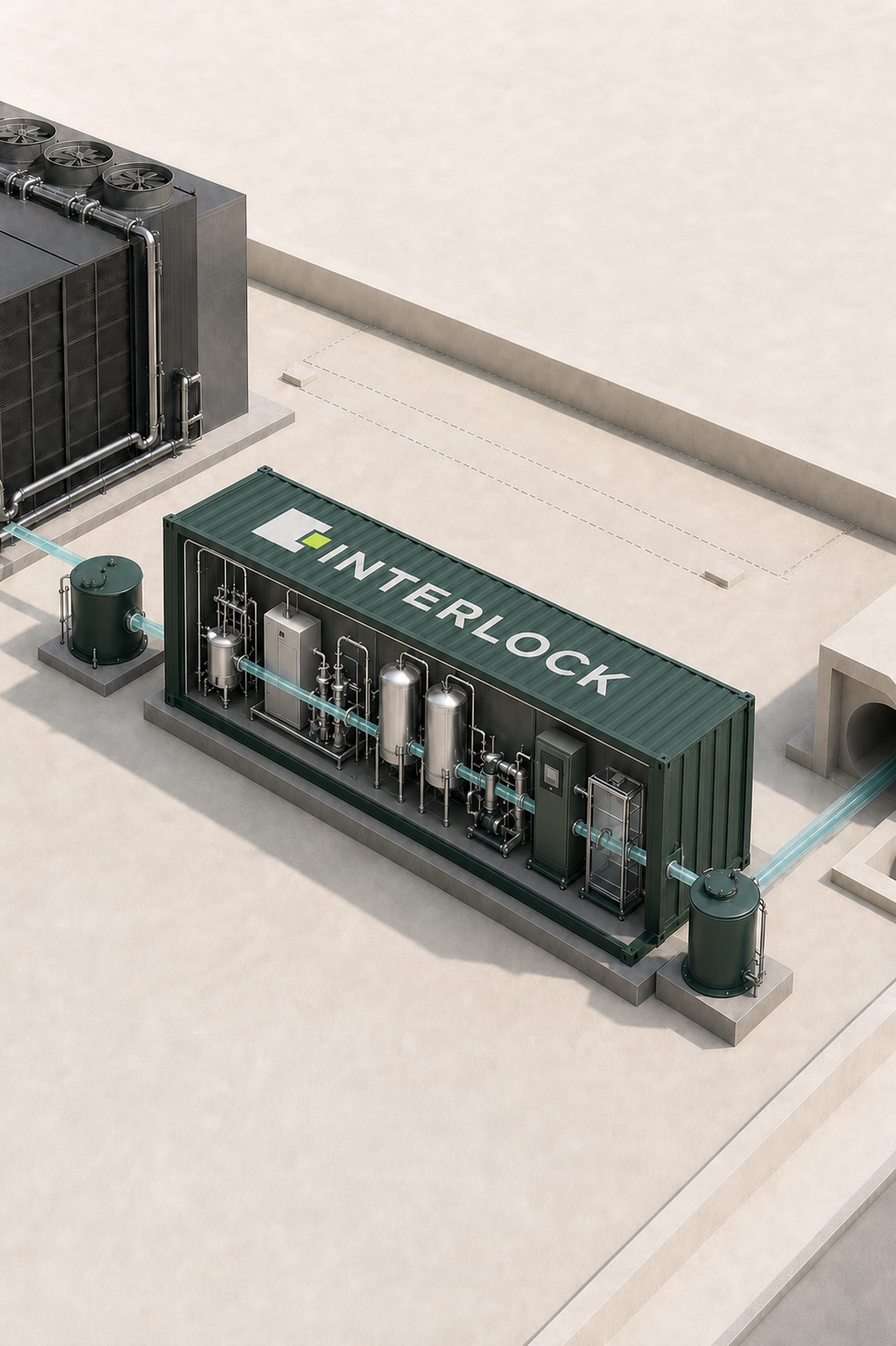
Interlock containerized blowdown-treatment system with equalization, conditioning, treatment, sensing, and verification equipment
01EqualizationExternal hydraulic buffer
02ConditioningAcidity, alkalinity, and oxidant control
03Treatment bayUltrafiltration (UF), nanofiltration (NF), reverse osmosis (RO), or biological treatment
04Sensor manifoldFlow, acidity, conductivity, and site-specific ion analysis
05VerificationFinal sampling and interlocked release

The operating risk

Data-center cooling is scaling faster than local wastewater capacity.

At water-cooled facilities, rising computing load means more heat rejection and more water cycling. Evaporation reduces volume but concentrates the minerals and treatment chemicals that leave as blowdown. 2,3

Permit and enforcement signals

Discharge constraints are already changing permits and operations.

4cited interventions
2022 to 2026
2022Litigation

Google's water use became a records fight.

The Dalles settled litigation over disclosure of site water use.8

2024Permit intervention

A court forced a cooling reassessment.

Chile partially reversed Google's permit and required a new water assessment. Google moved toward air cooling.9

2026Utility enforcement

Cheyenne revoked discharge privileges.

The utility issued a noncompliance notice and suspended relevant data-center discharges. Meta appealed the attribution.10,11

2026Individual review

Ohio retained individual permit review.

The state dropped a proposed general wastewater permit after public comment. New discharges remain individually reviewed.12

Solving the constraint requires major capital investment, redesign, and build time.

$10 million

Dedicated cooling-water line

Google is funding a dedicated cooling-water line in Lincoln, Nebraska.5

$31 million

Permanent blowdown reuse

Quincy's cooling-blowdown system took more than a decade to plan and build, with Microsoft financing capital and operations.6

$11.3 million

Illustrative cost of one quarter

A 50-megawatt shell and core at JLL's 2026 air-cooled benchmark costs about $565 million. Three months of simple capital carry at 8% equals $11.3 million, before lost revenue.13

JLL reports an 18-month average build and says 57% of 2025 projects were delayed by at least three months. 13

The challenge

Every waste stream is different. Every discharge agreement is local.

Utilities set local limits. Treatment needs change with source water, cooling additives, concentration, volume, and municipal capacity. The equipment can be modular. The water is site specific. 4

≈1,600local pretreatment programsEach may impose limits around its own treatment capacity and receiving waters. 4,16

The Interlock answer

Keep the cooling plant.
Fix the discharge.

A containerized backbone is configured with only the treatment, sensing, and controls required by the site and utility.

01

Characterize

Map blowdown flow and chemistry against the discharge agreement.

02

Configure

Install only the storage, metering, and treatment modules needed.

03

Verify

Confirm compliance before release and create the discharge record.

Design partners

Bring us the discharge constraint.

We are looking for data-center developers, operators, engineering firms, and utilities willing to evaluate a first site.

PILOT INTAKE OPEN

Early-stage design-partner outreach. No commitment required.

View sources
  1. 1Lawrence Berkeley National Laboratory: 2024 United States Data Center Energy Usage Report
  2. 2United States Department of Energy: cooling-water efficiency
  3. 3United States Department of Energy: cooling tower management
  4. 4United States Environmental Protection Agency: local pretreatment limits
  5. 51011 NOW: Lincoln dedicated cooling-water line
  6. 6United States Environmental Protection Agency: Quincy water-reuse system
  7. 7Uptime Institute: Annual outage analysis 2026
  8. 8PLOS Water: Four water insecurity concerns about data centers
  9. 9Reuters: Chile partially reverses Google data-center permit
  10. 10Wyoming Public Media: Meta appeals Cheyenne notice of violation
  11. 11Cowboy State Daily: Cheyenne suspends data-center wastewater
  12. 12WOSU Public Media: Ohio returns data-center discharges to individual permits
  13. 13JLL: 2026 Global Data Center Outlook
  14. 14United States Environmental Protection Agency: cooling-water intake rule
  15. 15American Water Works Association: Utility Planning for Data Centers
  16. 16United States Environmental Protection Agency: National Pretreatment Program Implementation